
The Manila shawl is a square silk canvas decorated in bright colours with flowers, birds or fantasies, and finished off with fringes around its entire perimeter. Of Chinese origin, it became very popular during the 18th century in Spain and Latin America as a complement to women’s wardrobes. He was immortalized by painters such as Joaquín Sorolla, Hermen Anglada Camarasa, Ramón Casas or Julio Romero de Torres.
In the traditional culture of women’s clothing, the Manila shawl is associated with the Andalusian woman, the manola from Madrid, traditionalism in the universal geography of Hispanic influence, flamenco and exotic elegance.
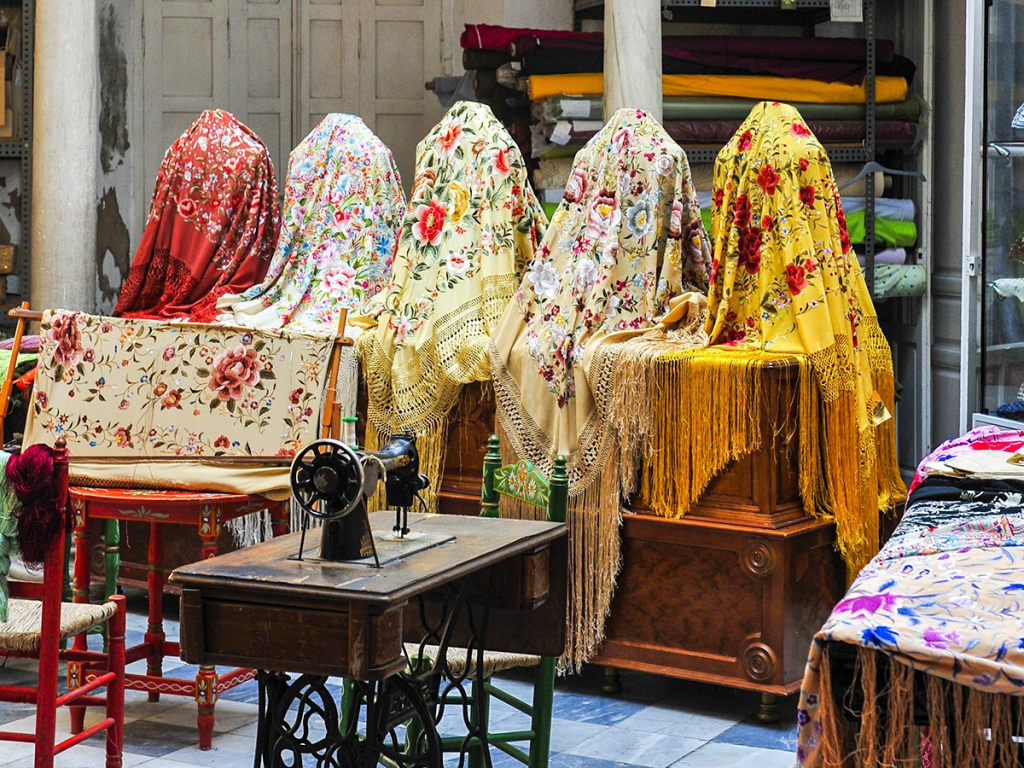
In flamenco
When in the first half of the 19th century, the powerful English textile industry and European fashions imposed their grey and opaque tones on women’s clothing, the Manila shawl, fell out of favour among the bourgeoisie, descended the social strata until it took refuge in the traditionalism of the Madrid manolas and the women of the gypsy castes more than most of the Spanish capitals. Their presence in the flamenco dance ceremony is one of the main resources of the grace of the “bailaora”, in addition to a rich feminine attribute in symbolism.
Depending on the palo, you could use the mantón, typically used in Alegrías, Bulerías as well as other palos.
Although it has become a fashion accessory capable of enhancing any look (even Queen Letizia has worn it on more than one occasion), the manila shawl is an accessory used, mainly by flamenco dancers, although sometimes they also wear it the singers.
In flamenco, the shawl (used well) is an essential complement to the dance, an extension of the movement of the expert bailaora, who handles the shawl as one more piece of her own body, giving it movement and showiness to the beat of the music.
Of course, the rhythm varies depending on the style that is being interpreted, but the movements are similar: close to the arms, accompanying the bailaora’s arm movement; agitated in front or behind the body; imitating the movement of a bull’s cape or, even, waved in a circular way pending from one hand.
Of course, to achieve harmony it is necessary for the bailaora to have experience and master the necessary technique: only in this way will she be able to turn the shawl into a part of her body and give it the same grace with which she moves it during the dance.
Although they are more common in the world of flamenco, as we have already explained, the use of the shawl has become widespread in many other areas and not only as a fashion accessory: zarzuela or cabaret are two musical styles that are far removed from flamenco, but in which it is also possible to find shawls that brighten up and decorate the movements of the dance group.
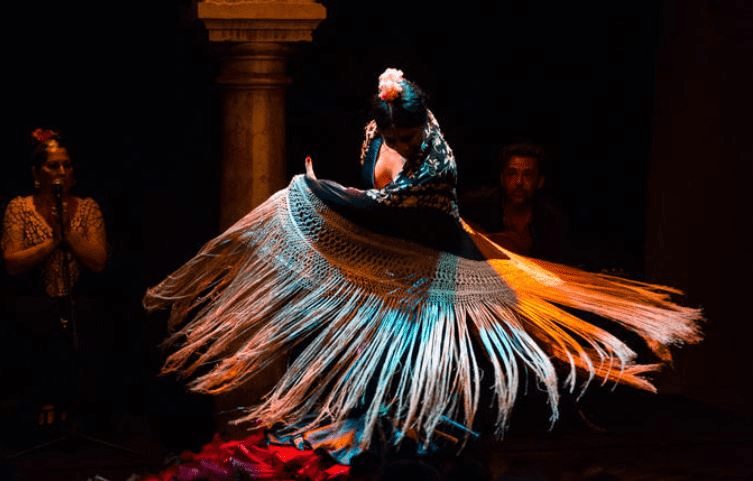
To ensure its showiness, drape and movement, the shawl used for the dance must meet a series of conditions:
- Made of natural silk and embroidered by hand: no two are exactly alike.
- It measures about 145 centimetres and has about 21 cm of latticework and about 30 fringes. In any case, bent diagonally it must cover the back and reach the tips of the bailaora’s fingers, with the arms extended perpendicular to the body.
- It must weigh enough so that it has a body and does not wrinkle during the dance: it is possible to find shawls weighing up to two kilos.
- In addition, in the case of dance shawls, it is prudent to choose one or the other depending on the style in which it is going to be used, the lighter ones being recommended for sevillanas or bulerías, which require more speed and dynamism, or colours very striking for rumbas, a more sensual dance. As for the colours, the most used are red, ivory, black or white.
How to choose a proper matón de manila

It not only depends on the dance in which you are going to use it but also on your physical complexion, your height and the dress with which you are going to combine it. Remember that the shawl should completely cover your back and reach the tips of your fingers with your arms stretched out in a cross. Also, when choosing the most suitable shawl for you, keep the following in mind:
- Embroidery: the most beautiful embroideries are those made with threads very close together and that occupy a large part of the shawl. However, they require much more work, which is why they usually significantly increase the price of the garment.
- Drawings: you can order an exclusive shawl, completely designed and personalized for you, but keep in mind that the complexity of the drawings can also increase your final price.
- Silk grammage: if you are going to use it occasionally, you can choose a finer material; for continuous use, especially in the case of professional dancers, thicker silk is required, with more body, consistency and durability.
- Latticework and fringes: when they are made by hand in natural silk, they give the shawl greater visibility, especially when dancing.
What do you think about this important instrument/accessory, it’s one of my favourites!
Let me know in the comments, see you in the next post 🥀


Happy New Year and Feliz dia de Reyes.
2025 was wild — a year of learning, unlearning, and reinventing myself more times than I can count.May this new year gather the very best of who you are: adventures that change you, journeys that open you, passions that set you on fire, dance, writing, drawing, and everything that still waits to be discovered. Dancing…


Athens
Unlike Santorini, Athens has an excellent public transport system, reliable, affordable, and incredibly useful for getting around the city. We arrived late on the 6th of November, so our real exploring began the following day. Before diving into the highlights, here are a couple of things worth knowing: On the way to the first museum,…

Santorini in 3 days
We recently visited Santorini for the first time and fell in love with every moment. Before diving into what makes this island so special, I’d like to share a few tips. That being said, we stayed for 3 and a half days. Here’s what we explored: We stayed at a beautiful place called Blue Eyes…
One response to “Mantón”
-

[…] the Manila shawl, the origin of the fan is Asian. It is believed to have originated in China in the mid-7th century. […]
LikeLike
#france #let'shelpaprincess #mountains #paris #part of my origins #portugal #travel #wine adventure architecture art author Blog & Travelling bloganuary bloganuary-2024-02 Buleria dailyprompt dailyprompt-1805 dailyprompt-2026 Dancinggiglio England Flamenco health Holamundo italy martinete motivation Mountains nature notebooks Part of my origins poem poetry Science seguiriya taranto The guitar is like a woman Traditions travel travelling wedding woman writing
 Dancing Giglio
Leave a comment