
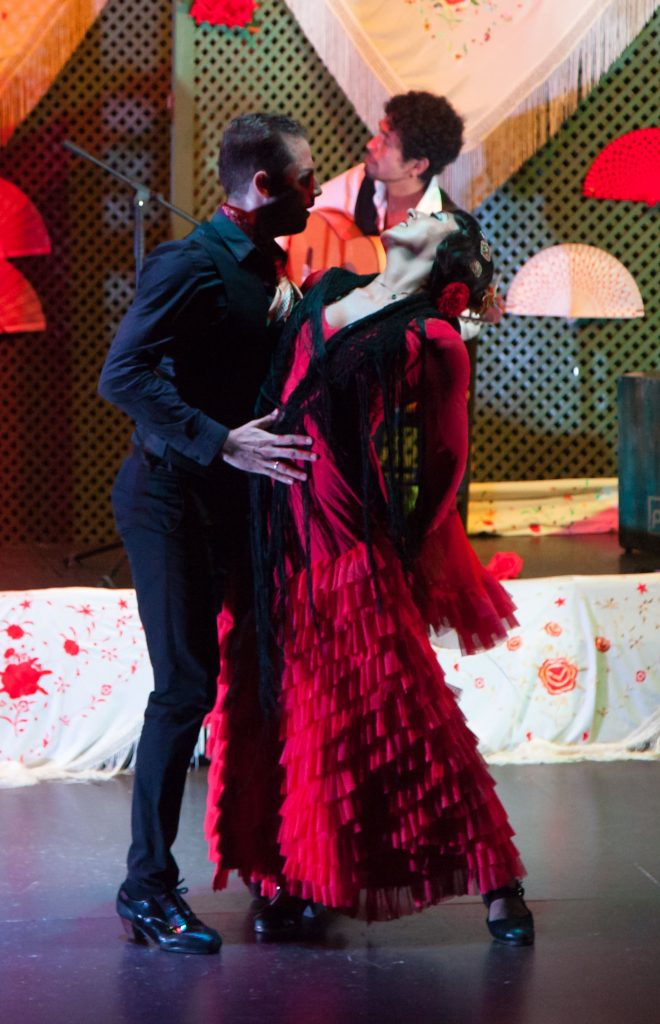
Fandango is a tree with roots that reach across Andalucía and with branches that keep growing.
Originally, the fandango was a dance that began to become popular in Andalusia at parties, musical numbers or in theatre tonadillas. That original fandango has little in common with what is known today.
He was instrumental and danceable at the time. His tone had a flawed tendency. From the Flemish fandango there is news about 1870, and everything indicates that it is a genre that emerged in Andalusia from the mixture of folkloric or traditional fandango, with the flamenco songs that were performed in Andalusian lands at that time.
The Andalusian atmosphere of the late nineteenth century, which coincides with the birth and proliferation of singing coffees, was the ideal environment for Andalusia to have its own fandango, the Flemish fandango.
The fandango is one of the fundamental styles of flamenco, not only because of what it represents as a style but because it has been a trunk from which other styles have emerged that have personality within flamenco singing, such as malagueña, granaína, taranta or mining , among others, which, based on flamenco, were constituted in their own styles.
Style
To study the fandango, and all those songs derived from it to which we have referred, it is convenient to make a classification of these songs, according to their historical appearance. And so we will have:
- Regional or local type Fandangos.
- Fandangos transformed into a specific flamenco style.
- Fandangos of personal or artistic creation.
The fandango is structured on a 3/4 measure and has a great tonal variety. The flamenco fandan copla consists of four or five octosyllable verses, which sometimes become six by repetition of one of them.
The Andalusian fandango, as we conceive it today, has a musical element that characterizes all its variants, popular and flamenco. This badge is based, on the one hand on the alternation of letters and instrumental variations, and on the other, on the tonality with which these songs are accompanied.
The Andalusian fandango shows numerous variants that, in an attempt to classify, would allow us to differentiate into popular fandangos and flamenco. Let’s say that the difference between one and the other is that the former is interpreted on a ternary compass (3/4), while the flamenco version has a free metric. Among the ‘compás’ fandangos, the numerous variants of Huelva, those of Almería, Lucena, the granaínos, those of Málaga, the verdiales stand out.
Dance
Each copla (verse) of the Fandangos de Huelva contains six sets of twelve counts, and dancers usually perform several verses of the song, or trade off performing a verse with another dancer.
In a performance, the guitarist plays two or four sets of estribillos before each copla. The singer may also sing the estribillo before the first copla.
When performed in the traditional, regional style, steps are characterized by beautiful leg gestures, flicks of the feet, jota steps and jumps, escuela bolera steps and patterns, a small amount of taconeo/zapateado, castanets, and a distinctive arched line in the back of the dancer – torcido – which produces a spiraling effect.
The dance is also often performed aflamencada, in a flamenco style that includes footwork, flamenco marking steps and cues, and llamadas and remates that are similar to those found in Bulerías.
The typical scenario for a traditional Fandangos de Huelva dance (performed by soloists or in groups) is as follows:
- Entrance/entrada
- Danced to a musical (with or without cante) estribillo
- 1st copla
- Each verse contains six sets of twelve count phrases, performed with or without castanets, and includes traditional regional or flamenco steps and phrases
- Estribillo transition
- Two to four sets of twelve count phrases are performed to the estribillo music, acting as transitions between the coplas (verses). These transitions allow dancers to enter or exit the stage.
- Arrimaté
- A traditional cierre (closing/ending) for cante and baile por Fandangos de Huelva.
 Dancing Giglio