
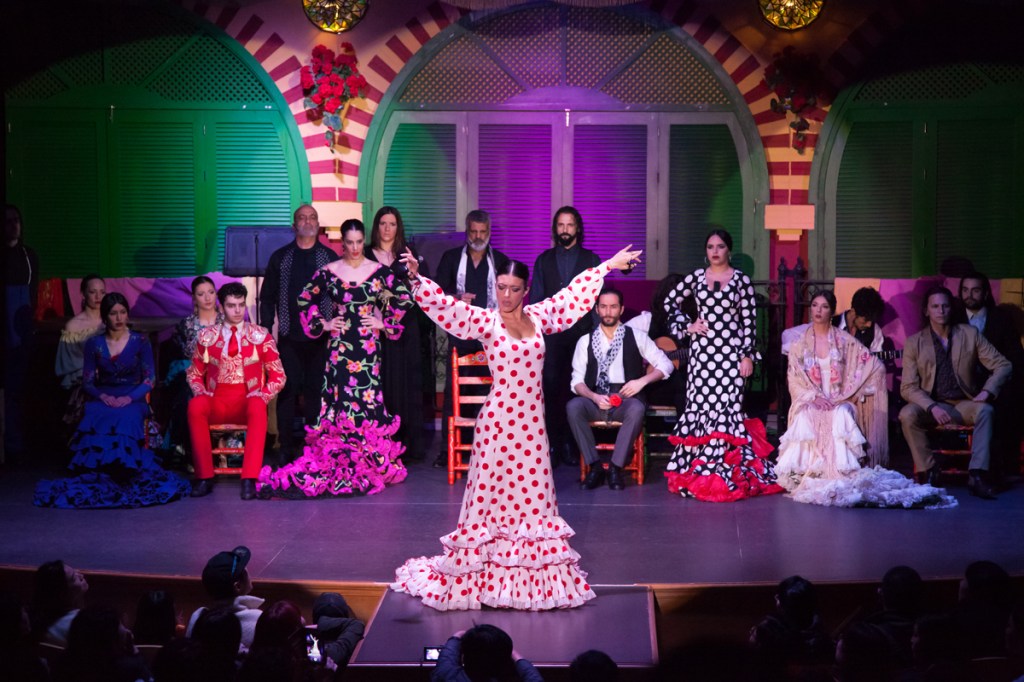
Spanish pronunciation: [ˈtaŋɡo]) is one of the flamenco palos closely related in form and feeling to the rumba flamenca. It is often performed as a finale to a flamenco tiento. Its compás and llamada are the same as that of the farruca and share the farruca’s lively nature. However, the tango is normally performed in the A Phrygian mode.
The first references that we find about the word «tango» as a popular song or dance, date back to the 19th century, with the name of «American tango» or «black dances». That is why many historians consider that the Tangos have an American or Caribbean origin.
This American tango, after its arrival in Spain in the 19th century, was linked to zarzuela and variety shows in small theaters and venues, adopting a mainly festive form. Little by little, these zarzuelas began to lose their American accent, to become flamencoized, thanks to the introduction of some elements of the Andalusian jaleos, with a triple beat, thus inserting them into the rhythm and beat of the American tango, and thus giving rise to a more flamenco form.
Its flamenco adaptation is usually linked to the areas of Cádiz, Jerez and Seville, although there are other regional variants, such as those of Málaga, Piyayo, Extremadura, Granada or Jaén.
The flamenco tango is distinct from the flamenco rumba primarily through the guitar playing. In Rumba the guitar flows more freely, whereas in Tangos the accents on beats 2, 3 & 4 are marked clearly with heavy strumming.
Its lively and very well marked rhythm, in 4/4, makes the tango moto suitable for dance, brilliant and expressive.
Tangos (like Tientos) are usually played on an Andalusian scale, but also on a major and minor scale, and sometimes letras are sung on different scales in the same piece.
They are played “por medio” (A, B flat, D minor, C7), and sometimes “por arriba” (E, F, A minor, G7). Sometimes other tones are also used, such as E7 or G minor
Of great importance in the development of the pole were the innovations of Camarón de la Isla: the tangos acquired, thanks to the great cantaor, the informal and open character of bulería, becoming almost a binary “cousin”.
Categories of Tango
There are several variants of tangos, which present important differences in structure, scale, melody, the theme of the letras, and speed, but a characteristic common to all tangos is the fact that they are suitable for dance.
It spreads throughout lower Andalucía and Extremadura.
Here is a number of possible kinds of tangos:
- Tangos de Cádiz, especially Tango de Jerez or Frijones
- Tango de Málaga or Piyayo Tangos de la Repompa Tango del guruguru (whose letras end with an estribillo: “al guruguru, al guruguru, al guruguru ay”)
- Tangos de Granada (the one with the greatest varieties: Tangos del Cerro, Tangos del camino, Tango del Sacromonte …)
- Tangos de Sevilla and in particular de Triana Tango extremeño (created by the gypsies of the Plaza Alta of Badajoz, in Extremadura, influenced by the Tango de Granada, with Portuguese echoes, and made famous above all by the record versions of Camaron).
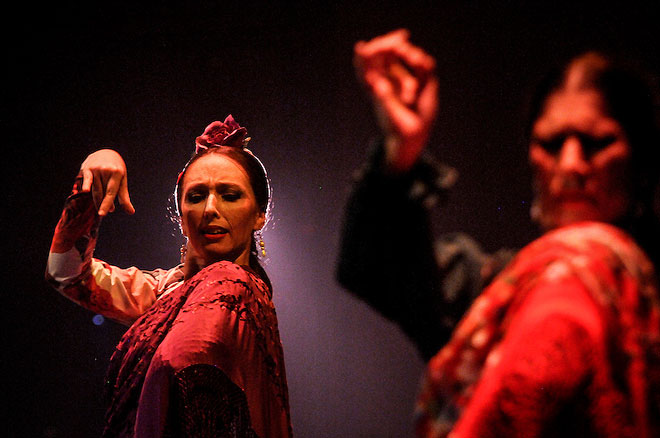
Dancing for Tangos
Usually, the development if not the creation of the baile por Tangos e por Tientos is attributed to the trianero Faíco (1880-1938) and to the Madrid-born Joaquín el Feo (1880-1940).
There are few bailaores who enjoy the great possibilities of this compás.
Tango is sensual and emotional and offers the possibility of nuances. It goes deeper than a gypsy rumba, with which it shares speed and compás.
The baile makes use of ‘llamadas’ of one or more compás, accentuated at the beginning of the sentence, similar to those used in the Farruca. The compás of tangos and tientos lends itself to improvisation. In addition to being structured in measures of 8, experienced artists are able to process phrases of 4 and even 2 beats, often to follow the cante. This flexibility brings enrichment and makes possible the constant evolution of Tangos and Tientos.
It is interpreted with agile, graceful, lively, mischievous, and playful movements. It lends itself very well to improvisation and favours personal interpretation and is a pole danced even by those who are not an expert in the baile, not necessarily requiring professional skills or special skills other than the joy of life and irony.
 Dancing Giglio
2 thoughts on “Tango”